
Video Slots Features
Video slots are among the simplest online casino games to understand and play. Choose your stake for each spin, press the ‘start’ button, and let the slot handle the rest.
The RNG takes over, the animations begin, and the slot technology controlling the bonus rounds, combination wins, and other features automatically shows and pays winning multipliers. Even when the software handles the process, however, some players reasonably want to know what is paying, where it appears, when it triggers, and why.
Understanding the technology behind online slots can make choosing a game more informed. That is the purpose of this guide. It outlines some of the more confusing slot mechanics used by major developers such as BTG, Yggdrasil, Pragmatic Play, Microgaming, and others, so you can identify the mechanics operating when selecting a video slot.
Ways-to-Win – (Adjacent Reels No Paylines)
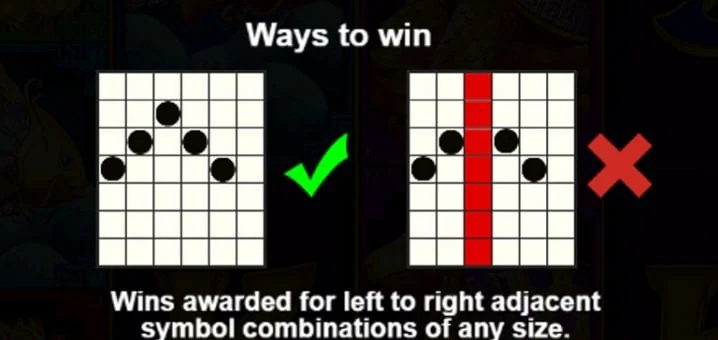
Video slots without pay lines are among the most frequently misunderstood examples of iGaming technology. Microgaming is generally identified as the first software provider to move away from pay lines. The now-defunct Lord of the Rings Jackpot slot introduced the 243-ways-to-win format without pay lines. These games retained a 5x3 reel layout but used ‘adjacent reels’ to establish winning combinations, a system that is straightforward once its rules are clear.
- For a combination to qualify as a win, its first symbol must appear on reel 1
- Every following symbol must be positioned on the next consecutive adjacent reel
- A 2-symbol win requires matching symbols on reels 1-2.
- A 3-symbol combination win requires matching symbols on reels 1-2-3
- The same sequence applies to 4-, 5-, and 6-symbol combination wins
- The symbol’s position on its reel does not matter (top-middle-bottom)
Beyond the no-pay-line 243-ways-to-win format, there are now…
- 1024-ways-to-win: After the 243-ways-to-win concept gained popularity, developers adopted the 1024-ways-to-win format, using 5x4 reels to provide additional winning routes.
- 4096-ways-to-win: Adding a 6th reel and arranging the game on a 6x4 grid allowed developers to produce 2000 ways-to-win games, including the well-known 4,096 ways-to-win format found in Playtech’s Buffalo Blitz virtual and live slots.
- 117,649-ways to win: Megaways slots retain the no-pay-line approach and its ‘adjacent reels’ rules for creating winning combinations, but add an important variation…
Megaways
Although BTG patented ‘Megaways’, Microgaming still deserves credit for the earlier ‘no pay lines’ concept. BTG changed the scope of ways-to-win games through its ‘Shape-Shifting Reels’. Some Megaways descriptions call these slots a 6x7 grid system, but that description is not quite accurate for the following reason…
- On any spin, one reel may display 2, 3, 4, 5, 6, or 7 symbols
- A spin might show 2-4-7-6-4-6 symbols across 6 reels, or it might show 7-7-7-7-7-7 symbols
- The number of Megaways varies from spin to spin according to how many symbols are visible
- To reach 117,649 ways to win, all 6 reels must display 7 symbols each: 7-7-7-7-7-7
This explains how Megaways slots can offer such a high number of ways-to-win and why they are known as ‘shape-shifting reels’. Other versions also exist, including Tiki Infinity Reels X Megaways, which changes between 2 and 5 symbols while offering unlimited Megaways because…
Infinity Reels
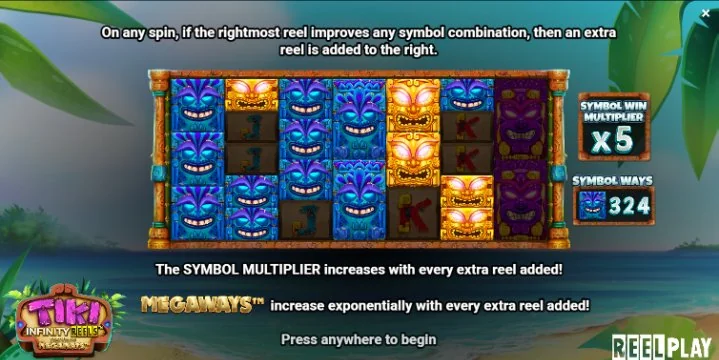
When this was originally written, the ‘Infinity Reels’ feature was still relatively new, with only a handful of titles, and the original review expected more to appear over the following years. As its name implies, the slot can keep adding reels. In the example used here, Tiki Infinity Reels X Megaways starts with 3 reels.
- If the 1st spin produces a 3-symbol win, the game adds a new 4th reel
- Only the newly added reel spins
- If the 3-symbol win becomes a 4-symbol win, the game adds a new 5th reel
- Only the newly added reel spins
- If the 4-symbol win becomes a 5-symbol win, the game adds a new 6th reel
That is the basic idea. The sequence may continue indefinitely, producing ‘Infinite Reels’ and, consequently, no fixed ceiling on the number of Megaways.
Cluster Wins a.k.a. Cluster Pays
Slots built around ‘Cluster Pays’ or ‘Cluster Wins’ offer a particularly different experience. Gemix 2 is one example. Instead of relying on ‘Pay Lines’ or ‘Adjacent Reels’, these games use a ‘Tetris’-style arrangement to create winning combinations. The groups are called ‘clusters’ rather than combinations.
- A cluster requires symbols to occupy adjacent positions, rather than simply adjacent reels
- Symbols may connect above, below, to the left, to the right, or diagonally
- Clusters may take the form of squares, rectangles, or other shapes
- Clusters commonly require at least 5 symbols
- Some clusters may combine 25 symbols
- Clusters may appear anywhere across the slot’s visible area
Rolling Reels or Cascading Reels
Most Megaways games, nearly all cluster-pay games, and some pay-line and ways-to-win slots use cascading reels. On Microgaming Slots: Features, RTP and Jackpot Games, the same feature is also called rolling reels.
- The game removes symbols involved in a winning combination from the reels
- Fresh symbols fall into the vacant positions
- A new combination does not necessarily produce a payout
- Any new wins are added to the spin’s existing winnings
- The reels keep cascading until no further wins appear
Win Both Ways

When a slot pays both ways, as Starburst, does, winning combinations can run from left-to-right or right-to-left. The ‘adjacent reels’ principle used by no-pay-line games can also apply to pay-line slots. For a right-to-left win, the first symbol must still begin on reel 1 and continue across consecutive reels; for the ‘Both Ways’ feature, the reverse direction begins on reel 5 and runs across consecutive reels.
- Combination wins can pay from left-to-right (Reels 1-2-3-4-5)
- Combination wins can pay from right-to-left (Reels 5-4-3-2-1)
Rounding Up Slot Tech
This video slot technology guide has covered several components that can make modern online and mobile slot gameplay seem confusing. These explanations provide newer players with a foundation for understanding the mechanics behind the technical terms used to describe a video slot’s main functions. For additional reading, see: